
Portable Mass Spectrometry for Tiletamine and Emerging Drug Detection: A New Tool for Law Enforcement
Introduction
The rapid emergence of new psychoactive substances (NPS) has become a growing challenge for law enforcement agencies, border control authorities, and public safety organizations worldwide.
Recently, China announced the inclusion of several substances, including Tiletamine, into the List of NonPharmaceutical Narcotic Drugs and Psychotropic Substances, strengthening regulatory control over these emerging addictive substances.
The new regulation will officially take effect on July 1, 2026.
This regulatory update highlights a broader trend in modern drug control: the transition from traditional drug enforcement toward rapid identification, field screening, and effective management of emerging psychoactive substances.
As new substances continue to evolve and appear in different forms, frontline officers require faster, more flexible, and more reliable detection technologies to support real-world enforcement operations.
1. Tiletamine Control Highlights the Need for Advanced Drug Detection Capability
Tiletamine is a veterinary anesthetic compound that has legitimate applications in animal medicine. However, due to illegal misuse, it has attracted increasing attention as a potential substance of abuse.
Unlike traditional illicit drugs, emerging psychoactive substances present several unique challenges:
Rapid changes in chemical structures;
Increasingly complex mixtures and formulations;
Concealed transportation and distribution methods;
Difficulty in identification through appearance alone.
In some cases, illegal substances may be hidden in products such as:
Electronic cigarette liquids;
Vape cartridges;
Liquid samples;
Ordinary consumer packaging.
These characteristics make rapid identification at the point of inspection increasingly important.
Modern drug detection systems must therefore provide not only accurate identification of known substances, but also the flexibility to adapt to constantly changing threats.
2. Why Traditional Laboratory Testing Alone Is Not Enough
Laboratory technologies such as:
Gas Chromatography-Mass Spectrometry (GC-MS);
Liquid Chromatography-Mass Spectrometry (LC-MS);
remain essential for forensic confirmation due to their excellent analytical accuracy.
However, laboratory-based analysis often requires:
Sample collection;
Transportation to a laboratory;
Professional analysis;
Generation of test results.
This workflow may not fully meet the requirements of frontline operations where immediate decisions are needed.
Examples include:
Police drug enforcement operations;
Border and customs inspections;
Transportation security checks;
Public venue inspections;
Emergency response situations.
For these scenarios, portable drug detection systems provide an important firstline screening capability by bringing analytical technology directly to the field.
3. Portable Mass Spectrometry Technology for Rapid Field Drug Identification
How Does Mass Spectrometry Enable Rapid Drug Detection?
Mass Spectrometry (MS) is an advanced analytical technology that identifies chemical substances based on their molecular mass characteristics.
During the detection process:
The sample is introduced into the instrument;
Target molecules are ionized;
Ions are separated according to their mass-to-charge ratio (m/z);
The obtained mass spectrum is compared with a reference compound library.
By analyzing unique molecular fingerprints, mass spectrometry provides highly specific identification of target compounds.
Advantages of Mass Spectrometry-Based Drug Detection Systems
High Identification Accuracy
Unlike screening technologies that rely mainly on characteristic signals, mass spectrometry provides molecular-level information, enabling more reliable identification of complex substances.
This is especially important for emerging psychoactive substances, where many compounds may have similar physical appearances or overlapping chemical characteristics.
Capability for Complex Sample Analysis
Illegal substances are often found in complicated forms, including:
Mixed powders;
Unknown liquids;
Electronic cigarette liquids;
Pharmaceutical-like products;
Chemical mixtures.
Portable mass spectrometry systems can analyze complex samples and provide valuable identification information directly in field environments.
Expandable Compound Libraries
As new psychoactive substances continue to emerge, detection systems require flexible database capabilities.
A modern portable MS system can expand its compound library through software updates, allowing users to respond to evolving drug threats.
4. Why Portable Mass Spectrometry Is Important for Modern Drug Enforcement
Traditional laboratory mass spectrometers provide excellent analytical performance but are usually limited to centralized laboratory environments.
Portable mass spectrometry brings advanced analytical capability closer to the point of need.
It enables:
On-site Screening → Rapid Identification → Evidence Support → Laboratory Confirmation
This approach helps law enforcement agencies improve operational efficiency while maintaining analytical reliability.
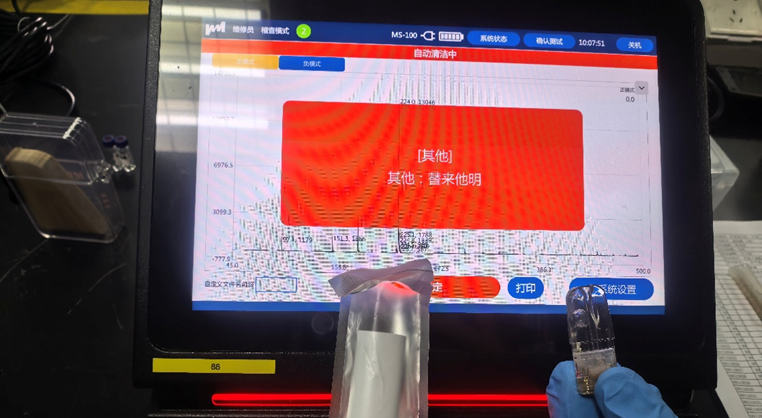
5. Weimu MS-100 Portable Mass Spectrometry Drug Detector
To address the increasing challenges posed by emerging psychoactive substances, Suzhou Weimu Intelligent Systems Co., Ltd. developed the MS-100 Portable Mass Spectrometry Drug Detector.
Based on advanced mass spectrometry technology, MS-100 is designed to support rapid identification of:
Traditional illicit drugs;
New psychoactive substances (NPS);
Emerging controlled substances;
Unknown chemical compounds.
Key Advantages of MS-100
Molecular-Level Identification
MS-100 analyzes compounds based on their molecular mass characteristics, providing high-specificity identification for challenging samples.
Detection of Emerging Substances
With an expandable compound library, MS-100 can support evolving drug control requirements, including newly regulated substances such as Tiletamine.
Field-Deployable Design
Unlike conventional laboratory instruments, MS-100 integrates analytical capability into a portable platform suitable for:
Police drug enforcement;
Border and customs inspection;
Public security operations;
Transportation security;
Emergency response.
Rapid Decision Support
By providing fast analytical results at the point of inspection, MS-100 helps frontline personnel quickly assess suspicious samples and make informed operational decisions.
6. The Future of Drug Detection: From Laboratory Analysis to Field Intelligence
The continuous emergence of new psychoactive substances requires more flexible and intelligent detection solutions.
Future drug detection systems will focus on:
Portable analytical capability;
Faster identification;
Larger compound databases;
AI-assisted data interpretation;
Real-time field decision support.
Portable mass spectrometry technology represents an important evolution in modern drug enforcement, bridging the gap between laboratory-level accuracy and frontline operational requirements.
Weimu MS100 provides a powerful field solution for law enforcement agencies, border security organizations, and public safety authorities seeking rapid and reliable identification of emerging drug threats.